1. The Initial Allure of No-Code Solutions
No-code platforms offer compelling advantages, making them an attractive starting point for many projects:
-
Rapid Development & Deployment: Projects can go from idea to launch in days or weeks, significantly accelerating time-to-market.
-
Reduced Initial Costs: Eliminates the need for expensive developers or extensive coding, lowering upfront investment.
-
Empowering Non-Technical Users: Business users can directly build and manage applications, fostering agility and reducing reliance on IT departments.
-
Quick Prototyping & MVP Creation: Ideal for testing ideas and gathering early feedback without significant resource commitment.
This rapid, accessible approach is perfect for validating a market, creating internal tools, or launching a simple online presence.
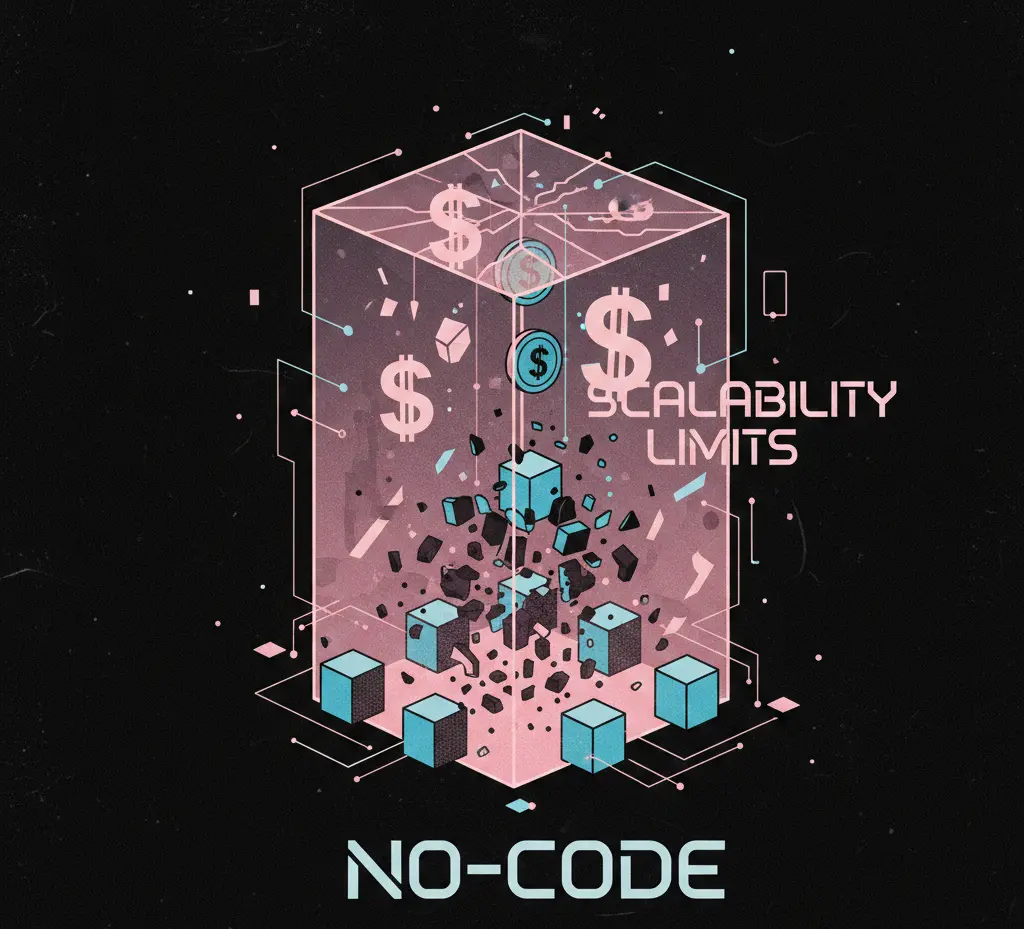
2. Hitting the "Glass Ceiling" of Scalability
While powerful for initial growth, no-code platforms inherently come with limitations that become evident as a business scales:
-
Vendor Lock-in and Limited Portability: No-code solutions operate within the confines of their specific platform's ecosystem. Businesses become heavily dependent on the vendor's features, pricing, and roadmap. Migrating data and functionality to another platform or a custom solution later can be incredibly complex, time-consuming, and expensive, as the underlying code and database structures are often proprietary.
-
Performance Bottlenecks at Scale: No-code platforms use generic architectures designed to accommodate a wide range of use cases. This generalism often means they are not optimized for specific high-traffic scenarios or complex computations. As user load increases or data volumes grow, performance can degrade significantly, leading to slow loading times, unresponsive applications, and frustrated users.
-
Limited Customization and Unique Business Logic: The drag-and-drop interface and pre-built components are excellent for standard functionalities. However, as a business grows, it often requires highly specific, unique features or complex business logic that cannot be easily implemented, or even imagined, within the rigid framework of a no-code builder. This restricts innovation and competitive differentiation.
-
Complex Integrations: While many no-code platforms offer integrations with popular tools, connecting to highly specialized, niche, or legacy internal systems can be challenging or impossible without custom code. This creates data silos and hinders efficient workflows.
-
Data Management Limitations: Handling very large datasets, performing complex database queries, or implementing sophisticated data analytics often exceeds the capabilities of most no-code platforms. Scaling data infrastructure and ensuring data integrity with growing complexity becomes a significant hurdle.
-
Cost Escalation at Scale: While initially cheap, as a business scales, it often needs to upgrade to higher-tier plans, purchase numerous add-ons, or implement workarounds to compensate for platform limitations. These escalating monthly fees can eventually become more expensive than maintaining a custom-coded solution, especially when factoring in the time and effort spent on workarounds.
-
Security and Compliance Concerns: While reputable no-code providers invest in security, businesses often have less direct control over the underlying infrastructure and security configurations. For industries with strict compliance requirements (e.g., healthcare, finance), the lack of granular control can be a significant barrier.
3. When No-Code Starts to Hinder Growth
The signs that a no-code solution is reaching its limits are often clear:
-
Frequent performance complaints from users during peak times.
-
Inability to implement critical new features required for competitive advantage.
-
High costs for workarounds or trying to force the platform to do something it wasn't designed for.
-
Struggles with data management, leading to inefficiencies or inaccurate reporting.
-
Security audit failures or compliance blockers.
-
Generic user experience that fails to differentiate the brand.
At this point, the initial benefits of no-code are overshadowed by the constraints, potentially stifling innovation and impacting customer satisfaction.
4. The Transition Point: Moving Beyond the Glass Ceiling
Recognizing when to transition from a no-code solution to a custom-coded or hybrid approach is a strategic decision. It requires a clear assessment of current performance, future growth projections, unique feature requirements, and budget. While replatforming can be a significant undertaking, it's an investment that frees a business from the constraints of the glass ceiling, allowing for true scalability, unlimited customization, and full control over its digital future. The cost of struggling with a hindering no-code platform, including lost opportunities and operational inefficiencies, can far exceed the expense of a well-planned migration.
Conclusion: No-Code as a Launchpad, Not a Destination
No-code platforms are incredibly powerful tools for initial development, prototyping, and empowering non-technical users. They serve as an excellent launchpad for ideas and an efficient way to achieve rapid market validation. However, for businesses with ambitions of significant growth, complex needs, or a desire for true competitive differentiation, no-code solutions eventually reveal their "glass ceiling." The real cost isn't just the platform's monthly fee, but the potential for stunted growth, compromised performance, and the eventual, often expensive, necessity of migrating to a more flexible and robust custom-coded solution. Strategic foresight dictates that businesses should view no-code as a valuable stage in their journey, not necessarily the ultimate destination for their core digital assets.