1. What Are Legacy Systems and Integration?
Legacy Systems are older computer systems, hardware, or software applications that are still in use because they fulfill specific functions, but often rely on outdated technology, programming languages, or architectural patterns. They are typically critical to core business operations but are difficult to maintain, extend, or integrate with modern systems.
Integration in this context refers to the process of connecting these legacy systems with newer applications, databases, or services to enable data exchange, automate workflows, or add new capabilities.
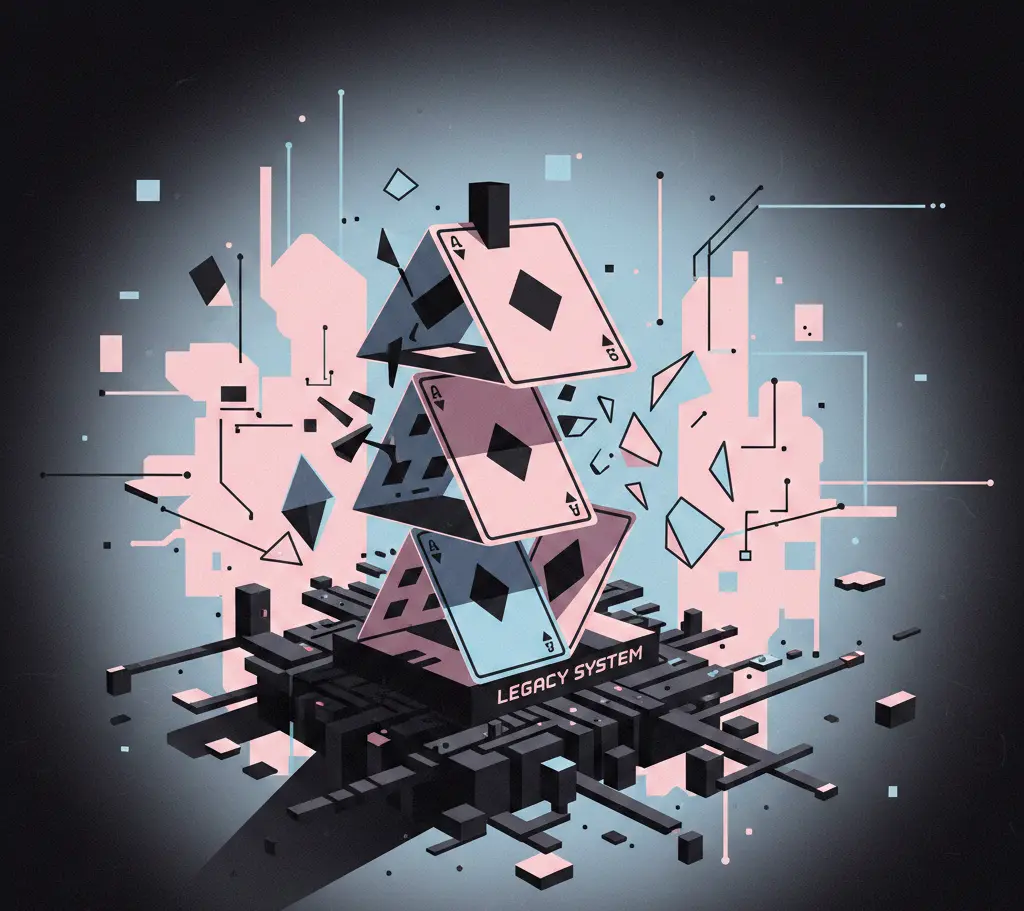
2. The "House of Cards Effect" Explained
The "House of Cards Effect" manifests due to several inherent characteristics of legacy systems and the nature of integration:
-
Lack of Documentation and Tribal Knowledge: Many legacy systems were built decades ago, and their original developers may no longer be with the company. Documentation is often scarce, outdated, or nonexistent. This means much of the system's inner workings, dependencies, and quirks exist only as "tribal knowledge" among a few long-serving employees, making changes incredibly risky.
-
Outdated Technologies and Architectures: Legacy systems often use programming languages, databases, or operating systems that are no longer actively supported or well-understood by modern developers. Their architectural patterns might be monolithic, tightly coupled, and not designed for modularity or external integration, making every point of connection a potential source of failure.
-
Tight Coupling and Undocumented Interdependencies: Over years, legacy systems become highly interconnected, often in undocumented ways. Different modules or even separate systems might rely on obscure data formats, specific processing sequences, or implicit assumptions. Changing one part, even a seemingly minor one, can have unforeseen ripple effects across the entire system, leading to unexpected failures elsewhere.
-
Rigidity and Resistance to Change: Due to their age, complexity, and interdependencies, legacy systems are inherently rigid. Even minor modifications can require extensive testing, as the potential impact is hard to predict. This rigidity makes them resistant to the agile and iterative development cycles of modern integration projects.
3. The Real Costs and Risks of Integration
The "House of Cards Effect" translates directly into significant financial and operational burdens:
-
Astronomical Development Costs: Developers spend an inordinate amount of time on reverse-engineering, deciphering undocumented code, and creating complex workarounds to fit new functionalities into old structures. This is far more expensive than developing for a modern, well-architected system.
-
Extended Timelines and Project Delays: The unpredictability of legacy systems leads to frequent roadblocks, unexpected issues, and prolonged testing cycles. Projects often exceed their initial timelines by months or even years.
-
Increased Maintenance Burden: The integrated system becomes a Frankenstein's monster, requiring specialized skills and constant vigilance to maintain. Every new patch, update, or feature addition risks breaking existing integrations, leading to a perpetual cycle of firefighting.
-
High Risk of System Instability and Downtime: A poorly executed integration or even a seemingly small change can destabilize the entire legacy system, causing critical business operations to halt. The financial cost of downtime for core systems can be catastrophic.
-
Security Vulnerabilities: Legacy systems often lack modern security features and are difficult to patch against new threats. Integrating them with modern systems can inadvertently expose the entire infrastructure to new attack vectors.
-
Resource Drain and Stifled Innovation: Valuable development and IT resources are tied up in maintaining and integrating with legacy systems, pulling them away from innovative projects that could drive future business growth.
4. The Illusion of Cost Savings
Businesses often opt for integration over replacement due to the perceived high upfront cost and disruption of a complete system overhaul. The logic is that "it's cheaper to adapt what we have." However, this perspective often only considers the initial quote for integration without factoring in the long-term, compounding costs of maintenance, delays, risks, and lost opportunities due to the "House of Cards Effect." The sum of these hidden costs often far surpasses the expense of a well-planned, phased modernization or replacement strategy.
5. Strategies for Navigating Legacy Integration (If Unavoidable)
While often perilous, sometimes integration is unavoidable. To mitigate the "House of Cards Effect":
-
Thorough Assessment and Technical Audit: Before starting, conduct an exhaustive audit of the legacy system to understand its architecture, dependencies, and existing technical debt.
-
Create an Abstraction Layer (API Wrapper): Instead of direct integration, build a stable API or "wrapper" around the legacy system. This isolates the legacy system, allowing new applications to communicate with it through a well-defined interface, minimizing direct interaction with fragile internal logic.
-
Incremental Modernization (Strangler Fig Pattern): Gradually replace or re-architect small, manageable parts of the legacy system rather than attempting a big-bang rewrite. This allows for continuous value delivery while slowly diminishing the reliance on the old system.
-
Robust Testing Regimes: Implement extensive automated testing, including regression tests, to catch unforeseen issues early.
-
Dedicated Expertise: Employ developers with deep experience in legacy technologies and a strong understanding of modern integration patterns.
Conclusion: Rebuild or Replace, Don't Just Integrate Blindly
The "House of Cards Effect" serves as a potent warning against underestimating the true cost and complexity of integrating with legacy systems. What appears to be a shortcut to modernization can quickly become a dead end of budget overruns, operational instability, and stifled innovation. Businesses must approach such integrations with extreme caution, a clear-eyed understanding of the risks, and a realistic budget that accounts for the inevitable challenges. In many cases, a strategic, phased replacement or comprehensive modernization initiative, despite its higher upfront cost, proves to be the more financially sound and less perilous path in the long run, ensuring a stable foundation for future growth rather than a precarious edifice prone to collapse.